No one wakes up thinking about replacing their ERP.
But many executives wake up worried about ERP issues they can no longer ignore.
The system that was meant to support growth begins to slow down processes. The data that should guide strategic decisions becomes unreliable. Operations that should run smoothly turn into a chain of exceptions, parallel controls and rework.
In mid-sized companies, particularly those experiencing growth, ERP issues rarely appear abruptly. They accumulate quietly until the entire organisation shifts into reactive mode. When that happens, the discussion is no longer technological – it becomes organisational.
This article is not about replacing an ERP.
It is about recognising the signs that the system is no longer supporting the business, and understanding why so many companies reach this point without realising it.
No one wakes up thinking about replacing their ERP
The decision to replace an ERP does not begin as a desire.
It begins as a consequence.
Unlike innovation initiatives, digital transformation programmes or the adoption of new technologies, replacing an ERP rarely emerges from a carefully planned strategic roadmap. Most of the time, it arises after months – or even years – of living with ERP issues that have become part of daily routine.
For CEOs, CFOs and operations leaders, the ERP should be invisible. It fulfils its role only when it operates in a stable, predictable and reliable way. The problem is that when this stops happening, the impact is not confined to IT.
It spreads across the entire organisation.
Why do ERP issues take so long to be recognised?
One of the biggest challenges is that ERP issues do not always present themselves as serious technical failures. In most organisations, they first appear as “minor inconveniences”:
- Reports that require manual adjustments
- Processes that rely on parallel spreadsheets
- Lengthy financial reconciliations
- Excessive dependence on key individuals
- Difficulty integrating new tools
- Slow responses to business changes
Individually, these symptoms may seem manageable. Together, however, they indicate something deeper: the ERP is no longer keeping pace with operational complexity.
In SMBs, this scenario is even more common. Many have grown rapidly, added new products, channels, business units or operating models, yet retained an ERP that was implemented for a completely different reality.
ERP issues are not a technical matter – they are a business matter
A common mistake within organisations is treating ERP issues as if they were solely the responsibility of IT.
In practice, when an ERP does not function properly, the impact spreads across four critical business dimensions:
1. Operations
Critical processes become stalled or overly manual.
Teams spend more time “making the system work” than operating strategically.
2. Finance
Lengthy closing cycles, complex reconciliations and difficulty trusting reported figures. Finance begins working with safety margins instead of accurate data.
3. Governance
Leadership loses visibility and control. KPIs arrive late, incomplete or inconsistent, making board-level decision-making more difficult.
4. Strategy
Growth becomes risky. Any move – expansion, acquisition or new channel – feels more complex than it should because the system cannot keep up.
When these four areas begin to fail simultaneously, the problem is no longer operational. It becomes structural.
The most common signs of ERP issues in SMBs
While every organisation has its own reality, clear patterns emerge when analysing companies facing ERP issues.
Excessively manual critical processes
When essential activities depend on spreadsheets, parallel controls or constant cross-checking, the ERP has ceased to fulfil its purpose.
The system becomes merely a data repository, not an operational engine.
Lack of confidence in reported data
If different departments present different figures for the same KPI, something is wrong. The absence of a single source of truth undermines strategic decisions and creates tension between teams.
IT constantly firefighting
When the IT team operates predominantly in reactive mode, resolving urgent issues, there is little room left for innovation, continuous improvement or planning.
Difficulty integrating with other solutions
In an increasingly connected world, an isolated ERP becomes a bottleneck. The more complex and costly integrations are, the greater the warning sign.
Growth becomes synonymous with risk
When expanding operations, opening new branches or launching new products requires system “workarounds”, the ERP is limiting the business rather than supporting it.
When replacing the ERP is no longer a choice
There is a critical moment in many organisations when the question shifts from if the ERP needs to change to when and how.
This usually happens when:
- The hidden costs of ongoing issues exceed the cost of change
- The board begins to question the reliability of the data
- The business loses agility compared to competitors
- Teams show signs of operational exhaustion
- Operational risk becomes greater than transition risk
At this point, replacing the ERP stops being a technical decision and becomes a strategic one.
The silent impact of ERP issues on leadership
For executives, perhaps the greatest damage caused by ERP issues is invisible: the loss of predictability.
Without reliable data and stable processes, leadership begins making decisions based on:
- Intuition
- Past experience
- Parallel reports
- Manual adjustments
This does not mean leaders are no longer competent. It means the system is no longer supporting decision-making at the level the business requires.
Over time, this affects board confidence, management credibility and the ability to plan the future with certainty.
Why do many companies stay with an inadequate ERP for longer than they should?
Even in the face of clear warning signs, many organisations postpone the discussion. This delay rarely stems from a lack of awareness, but rather from a combination of accumulated factors.
Fear of the complexity involved in replacement is often the first barrier. Many leaders associate ERP change with lengthy, high-risk and highly disruptive projects. In other cases, negative past experiences create internal resistance and reinforce the belief that “it’s better to live with a known problem than face the unknown”.
Lack of time is another factor. With operations under pressure, urgent priorities consistently outweigh structural decisions. The inadequate ERP becomes part of daily life, and temporary fixes gradually turn into permanent solutions.
There is also the perception that “we can still manage”. As long as the business continues operating – albeit with extra effort – ERP replacement is pushed further down the road. The problem is that postponement does not eliminate the cost. It merely redistributes it silently across operations, overburdens people and compromises long-term strategy.
By the time the decision finally reaches the table, the impact is no longer technical. It is already reflected in lost efficiency, reduced predictability and difficulty sustaining growth.
The role of ERP in business maturity
An ERP is not merely a transactional system.
It is the backbone of operations.
As a company matures, its ERP must evolve alongside it. This means:
- Keeping pace with process complexity
- Supporting strategic decision-making
- Integrating easily with other solutions
- Ensuring stability and security
- Evolving without constant disruption
When this does not happen, ERP issues become inevitable.
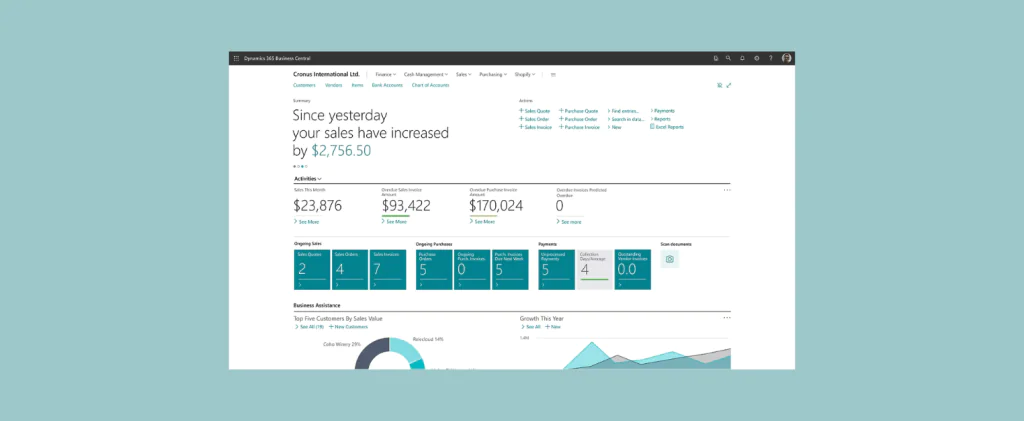
Business Central: preventing the problem from reaching breaking point
Within this narrative, Microsoft Dynamics 365 Business Central is not positioned as “the most modern ERP”.
It is positioned as the ERP that prevents the business from reaching a breaking point.
Business Central is designed for companies that require:
- Operational stability
- Native coverage of core business processes
- A single, reliable source of data
- Seamless integration with the Microsoft ecosystem
- Continuous evolution without traumatic projects
Instead of reacting to crises, it helps maintain the business in a state of predictability and control.
ERP as an enabler, not an obstacle
Companies that achieve sustainable growth share one thing in common: their systems work in favour of their strategy.
When the ERP functions as it should, it:
- Reduces friction between departments
- Increases confidence in data
- Frees up team capacity
- Supports faster, safer decisions
- Enables scaling with less risk
This is the opposite of the scenario faced by companies dealing with ERP issues.
Nexer’s role in this journey
More than implementing technology, Nexer acts as a strategic partner in understanding the organisation’s current stage.
This means:
- Gaining a deep understanding of operations
- Identifying genuine signs of ERP strain
- Assessing risks and opportunities
- Aligning technology with strategy
- Managing the transition in a safe and structured way
Replacing an ERP is not the beginning of transformation.
It is the sign that something is no longer working.
Recognising the issue is the first step
No one wakes up thinking about replacing their ERP.
But many wake up feeling the effects of ERP issues that have gone beyond the ideal point.
Recognising these signs is not a failure of leadership.
It is a sign of maturity.
Business Central exists so that companies no longer need to operate in emergency mode – and so leaders can return their focus to what truly matters: growing with control, predictability and confidence.